


LONG-DURATION BATTERY STORAGE WITHOUT THE LITHIUM-ION COMPROMISE
Vanadium redox flow batteries offer long life, deep cycling, low fire risk and stable performance for energy storage applications where battery life, duration and safety matter.
Australia is moving rapidly towards a renewable electricity system, but more solar and wind generation does not by itself solve the problem of dispatchable power. The market needs storage that can shift energy across the day, support the grid, reduce network dependence and provide reliable power when renewable generation is not available.
Lithium-ion batteries have an important role to play, particularly for short-duration, high-power applications. However, not every storage problem is a lithium-ion problem. For projects that require long duration, frequent cycling, long operating life, fire safety and stable performance over decades, vanadium redox flow battery technology deserves serious consideration.
Why now?
Australia’s energy system is changing quickly. The Commonwealth Capacity Investment Scheme is designed to support new renewable generation and dispatchable storage, with the goal of helping achieve 82% renewable electricity by 2030 and delivering additional renewable and clean dispatchable capacity. AEMO’s Integrated System Plan identifies the need for major investment in generation, storage and transmission to support the transition of the National Electricity Market to net zero.
For New South Wales specifically, the energy roadmap includes at least 2 GW / 16 GWh of long-duration storage by 2030. This requirement cannot be met intelligently by treating every battery as if it has the same life, risk profile, operating behaviour and residual value.
01.
Built for long duration
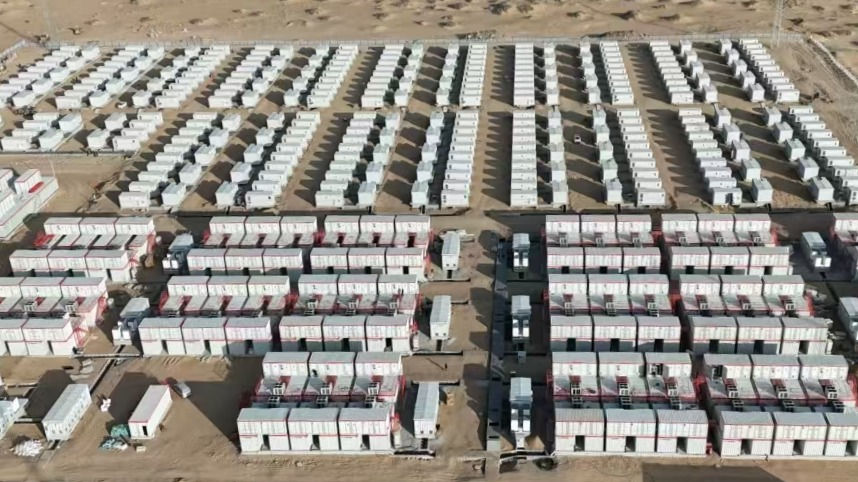
VRFB systems are particularly well suited to 4-hour, 6-hour, 8-hour and longer-duration storage applications where the project depends on daily cycling and long operating life.
02.
Designed for safety
VRFB electrolyte is water-based and does not have the same thermal runaway risk profile as lithium-ion chemistry. This makes it highly relevant for behind-the-meter industrial, infrastructure, mining, data centre and commercial applications where fire risk is a major consideration.
03.
Built for life-cycle economics
A battery should not be assessed only on initial capital cost. VRFB should be assessed on levelised cost of storage, operating life, cycle life, degradation, residual value and the ability to separate the cost of power from the cost of energy.
04.
Commercial structures that can change the result
Because a significant part of VRFB system cost sits in the vanadium electrolyte, commercial models such as electrolyte leasing, residual value recognition, supplier co-investment and long-dated funding can materially change project economics.
How a Vanadium Redox Flow Battery Works


01.
02.
Vanadium Redox Flow Power Cell
ELECTROLYTE SOLUTIONS
FLOW MECHANISM
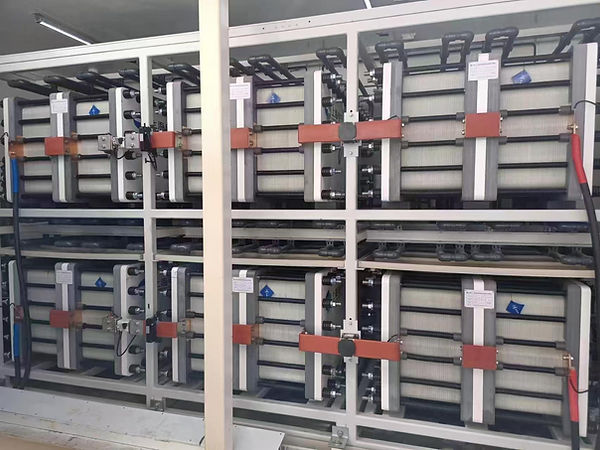
The VFB consists of two separate electrolyte solutions, each containing vanadium ions dissolved in sulfuric acid. These solutions are stored in external tanks and pumped through the battery's electrochemical cells.
The electrolytes are pumped through a cell stack, which contains a series of electrochemical cells. Each cell comprises two half-cells separated by an ion-exchange membrane.
03.
ELECTROCHEMICAL REACTION
-
In the positive half-cell (cathode), the electrolyte contains vanadium ions in the VO₂⁺ and VO²⁺ oxidation states. In the negative half-cell (anode), the electrolyte contains vanadium ions in the V²⁺ and V³⁺ oxidation states.
-
During charging, an external power source drives the redox reactions, causing vanadium ions in the positive electrolyte to be oxidised and those in the negative electrolyte to be reduced.
-
During discharging, the stored chemical energy is converted back into electrical energy as the redox reactions are reversed, allowing electrons to flow through an external circuit, providing power.
04.
MEMBRANE FUNCTION
The ion-exchange membrane allows ions to pass through while preventing the mixing of the different oxidation states of vanadium, maintaining the battery’s efficiency and capacity.

We help our customers assess, specify, procure and finance battery storage systems across three technology families:
Technology
Vanadium Redox Flow Batteries
Lithium-ion Batteries
Semi-solid Lithium-ion Batteries
Best suited to
Long-duration, long-life, high-cycle stationary storage
Short duration, high-power, grid and commercial storage
Higher-density lithium-based systems with potential safety and lifecycle advantages.

Comparison of Storage Capacity and Storage Duration:


SAFE
ECONOMICAL
LONG LIFE
PROVEN